



Insulating Glass Units
Thermal insulation glass – GlasMax Thermo, GlasMax SuperThermo
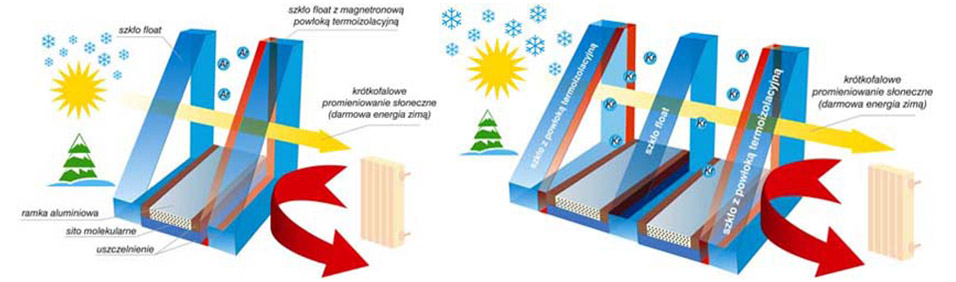
In today’s world, high-performance thermal insulation is a key element of ecologically and economically conscious construction technology. To minimize heat loss from inside to outside, windows are fitted with thermal insulation glass with low-emissivity coatings, such as ClimaGuard Premium, applied on the inside of the insulating glass unit.
Installing thermal insulating glass ensures high indoor comfort by reducing cold drafts and condensation. Filling the cavity between the panes with noble gases such as argon or krypton further reduces heat loss.
The key parameter describing the thermal insulation properties of IGUs is the thermal transmittance coefficient U (W/m²K), calculated according to EN 673. The lower the U-value, the better the thermal insulation.
Double-chamber IGU: U = 0.7 to 0.5 [W/m²K]
Single-chamber IGU: U = 1.6 to 1.0 [W/m²K]
Sound insulation glass – GlasMax Silent, GlasMax SuperSilent
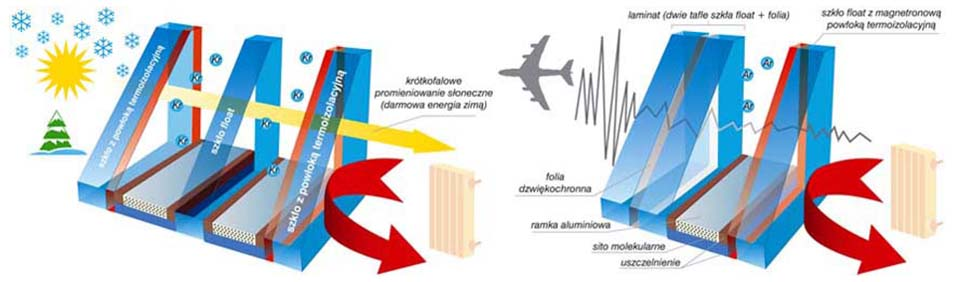
Noise protection plays a crucial role in our quality of life and should be used where noise sources cannot be eliminated. High acoustic performance is achieved by laminated glass with special acoustic foils, increased glass mass, asymmetrical structures, and heavy gas fillings.
The sound insulation depends largely on the glass structure but also on the window profile, hardware, and professional installation. The sound reduction value is hard to calculate and should be selected by specialists.
Acoustic protection can be combined with other functions like thermal insulation or safety. Sound insulation is assessed per EN 12354, with acoustic values given as weighted sound reduction index Rw and adaptation factors C and Ctr. Depending on construction, IGUs achieve Rw = 28 to 53 dB.
Safety glass – GlasMax Safe

Wherever glass is used, safety is paramount. Safety glass is designed to protect people from injury by sharp fragments in case of breakage. GlasMax Safe is laminated safety glass that meets many requirements of modern architecture – from light control and thermal insulation to the protection of building occupants.
Even if it breaks, laminated glass remains in the frame and continues to serve its purpose.
Safety glass is recommended in doors, partitions, glass façades, balconies, vestibules, balustrades, and fall-prevention areas. It is classified according to EN 12600 using a pendulum impact test. Classes depend on the drop height and fracture pattern.
Burglar-resistant safety glass – GlasMax Secure

This glass is designed to protect homes from burglars. When used with reinforced fittings, additional protections like bars or shutters may be unnecessary, maintaining the building’s aesthetics. GlasMax Secure is laminated and customizable with various glass and PVB foil combinations. More layers mean more security.
For residential use, classes P3A and P4A are most common (2 glass panes + 3 or 4 foil layers), often recognized by insurers, which can reduce premiums by 5–10%. Burglar-resistant glass is classified according to EN 356 via a free-falling steel ball impact test. Classes: P1A–P5A.
Solar control glass – GlasMax Sunblock, Supersunblock
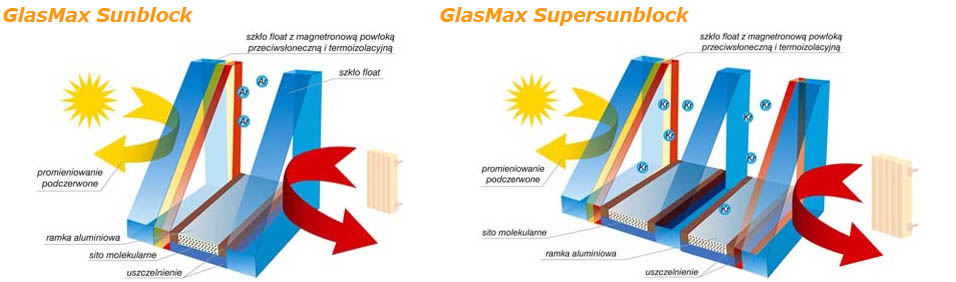
These prevent overheating, increase comfort, and reduce cooling costs, especially in commercial buildings. Modern solar control glass also has excellent thermal insulation, minimizing winter heat loss.
Available in grey, blue, or neutral tones and with high light transmission, these glass types are also suited for residential use.
The key parameter is the solar factor “g”, indicating the total solar energy transmittance, calculated per EN 410. The lower the “g”, the better the solar protection.